- The brief is the work. A prompt describes a picture; a brief names the offer, the audience, the objection it kills and the one line you want remembered.
- Feed it your real product. An ad built from a description of your product sells a product you do not make.
- Ask for four angles, not ten ads. Ten versions of one idea is one test.
- Eight tells give away an AI ad, starting with hands, in-image text and a redrawn logo. Run the checklist before you spend a dollar.
- Name every ad after its angle. If the report cannot tell you which idea won, the volume was wasted.
- Or skip the steps. In Sandstorm, “give me ads” runs all seven, and you never have to learn the software.
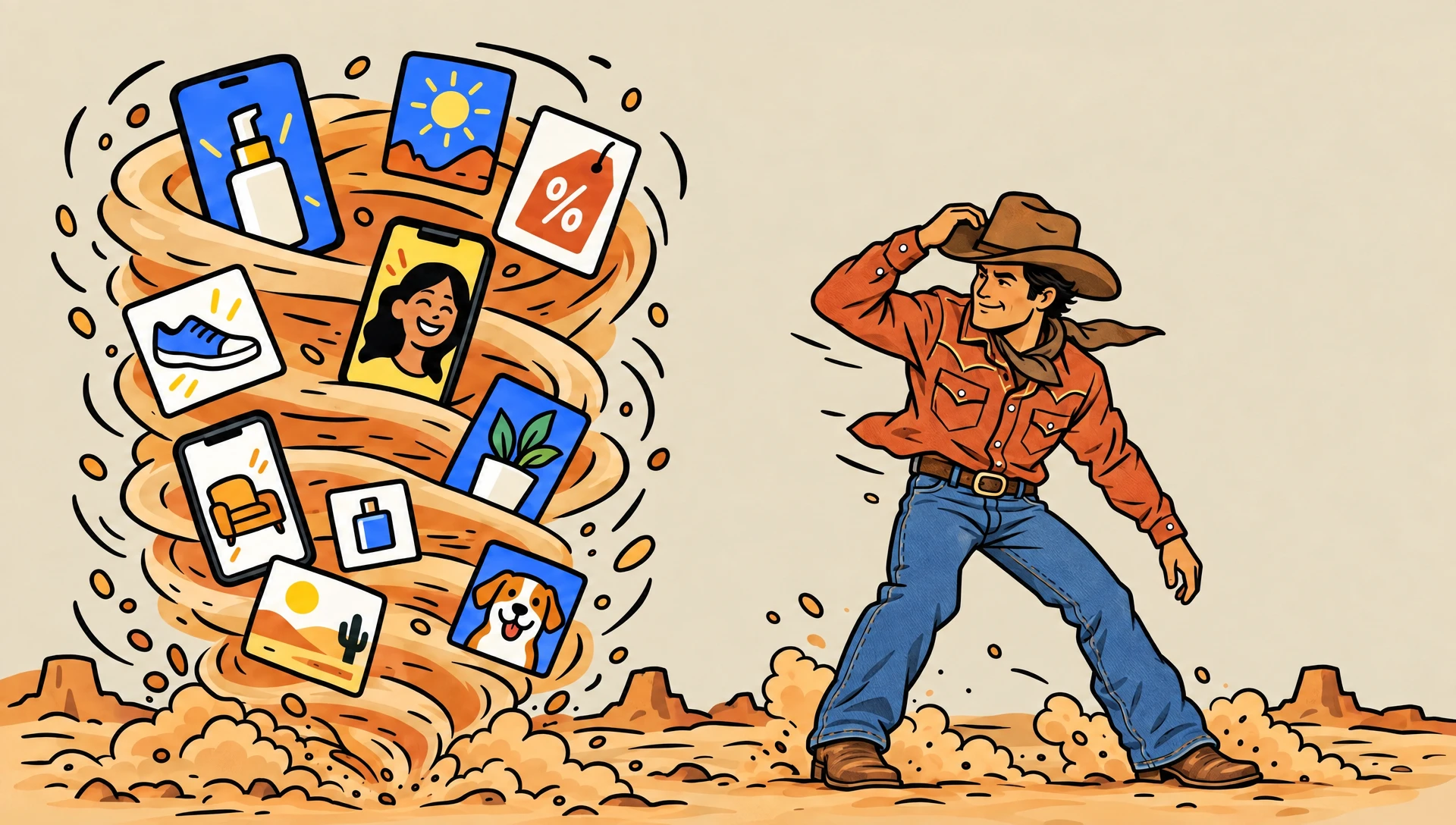
The most expensive ad I have ever run stars a cowboy who does not exist. Almost a quarter of everything we have ever spent on Meta has gone behind that one video, and it is still running.
The cheapest leads I have ever bought came from a photo of a subway platform with lowercase text typed over it, like a note to a friend. No art direction, no logo. Its leads cost 44% less than the cowboy’s.
I would have bet the other way. That is not a failure of judgment, it is the actual news: being wrong got cheap. You no longer have to defend one idea for a quarter. You can afford to test four by Friday.
Because the thing AI is good at is not taste. It is volume, variation, and having no ego about the concept it just made, which is more than most of us can say. A picture is decoration. An ad is an argument: here is your problem, here is the thing that fixes it, here is why you should believe me, here is what to do next. Most AI tools are very good at the picture and completely indifferent to the argument.
So here is everything it actually takes, in seven steps. Every one of them works by hand, with any tool, and I will show you how. Under each one I will also show you the same step in Sandstorm, where the answer is always the same. You do not do it. You say give me ads, and the agent does.
What Making Ads With AI Actually Involves
“Making ads with AI” covers three different jobs, and they get conflated constantly.
- Copy. Hooks, headlines, primary text, captions, the call to action.
- Visuals. Statics, video, carousels, and creator-style footage that looks like it was shot on a phone.
- Delivery. Which ad goes to which audience at what budget, what gets paused, what gets more money.
Most tools do one of those and call themselves an AI ad generator. An image tool that cannot see your ad account. A copy tool that has never seen your product. A dashboard that cannot change anything it reports on. The handoffs between the three are where the time goes.
Every step below is either feeding the machine something it cannot know, or checking the part it cannot judge. By hand, that is your job. In Sandstorm, it is the agent’s.
Step 1: Write the Brief Before You Write the Prompt
A prompt describes a picture. A brief describes an argument. If you take one thing from this article, take the difference.
Here is a prompt: a photorealistic image of a coffee bag on a marble counter, morning light, shallow depth of field. You will get exactly that. It will be pretty. It will sell nothing, because nothing in it is a reason to buy.
Here is a brief. Six fields:
- Who. One person, specific enough to picture. Not “coffee drinkers.” Someone who owns a Keurig and feels slightly embarrassed about it.
- The offer. What they get, what it costs, and why that is a better deal than what they are doing today.
- The objection. The single reason this person does not buy. Price, trust, effort or timing. One per ad, never four.
- The angle. The way in. A myth you bust, a comparison, a demo, a before and after, a customer’s own words.
- The one line. If they remember nothing else, what is the sentence?
- The proof. The number, the review, the certification, the guarantee. The thing that makes the claim survivable.
Here is that brief filled in for the lowercase ad from the top of this article, the cheapest source of leads we have ever had at any real volume:
- Who. A founder who has been told to run ads, has no designer, and suspects everyone else knows something they do not.
- The offer. Software that finds the ads already working in your category and builds you your own, in minutes.
- The objection. They have been promised this before by a tool that produced garbage, and they are not going to be fooled twice.
- The angle. A friend asking for a gut check, not a company running an ad.
- The one line. It watches the top ads on the platform and makes you new ones.
- The proof. Three friends, real money, this month.
That is the whole input. If you are working by hand, what you type is one instruction built out of it:
A photo taken on a phone, no styling, no logo. Lowercase text typed over it like a note to a friend. It opens by asking whether you would use this, says it watches the top ads on a platform and builds you new ones, and ends with what it has already made for three people.
Nothing in there about composition, lighting or lens. Every one of those decisions is downstream of the argument.
If you want to see those six fields filled in by a brand that is very good at this, read the Atlas Coffee Club breakdown. “There’s no such thing as an espresso bean” is the angle field. “65 cents a cup, cheaper than Starbucks” is the objection field. Neither of them is a picture.
In Sandstorm
You do not write it. Say give me ads and the agent writes a brief for every ad itself: it picks the offer, studies what has already won and what you rejected, and gives each ad its own angle, audience and headline, so you get different ideas rather than the same ad three times. It writes the prompts as well, each one shaped for whichever model suits the shot. You never see a prompt unless you want to.
And if you do have an opinion — this offer, that audience, nothing green, the product never in the first three seconds — say it once. It will follow it. You just do not have to.
Step 2: Feed It Your Actual Product, Not a Description of It
This is where most AI ads die, and it happens before the first image is made.
Describe your product to an image tool and it will invent one. Close, but wrong. The label is off, the cap is the wrong colour, the logo is a smeared approximation of your logo. You are now advertising a product you do not sell, which is a legal problem before it is a marketing problem.
So give it the real thing, once:
- Product photos. Several angles, clean background, the highest resolution you have, with the label legible. Your store gallery is usually enough.
- Your logo as a file. Not a screenshot of your logo. A file.
- Your colours and type, by name and by value, so ad number twelve matches ad number one.
- Your real claims, written out. The guarantee, the price, the shipping promise, the things you are allowed to say.
- Two or three ads you wish were yours, as a reference for the look you are after.
Once. Not per ad. Everything downstream inherits it, and the gap between an AI ad that looks like your brand and one that looks like a stock photo is almost entirely this step.
In Sandstorm
It already has your product. Connect your site and your ad accounts once and it learns your products, photos, logo, fonts, colours, offers and voice from them, plus anything else you hand it, from brand guidelines to the transcript of last week’s sales call. Every correction you make is remembered, per brand and per person, so the first time you say the logo never goes on a dark background is the last time you have to. Ad two hundred still looks like ad one.
Step 3: Ask for 4 Ad Angles, Not 10 Ads
The instinct is to ask for ten ads. Ask for four angles instead, then build each one out.
Ten versions of one idea is one test with a large sample. Four different ideas is four tests, and one of them is going to beat the others by a distance you would not have predicted. You do not know which one, and no amount of staring at them will tell you.
Six angles that reliably work on people who have never heard of you:
- The myth. Something everyone in your category believes that happens to be wrong. It stops the scroll and makes you the one who knows.
- The comparison. You against the thing they are doing today, stated without insulting them for doing it.
- The demo. The product doing the single thing it is best at. Works with the sound off, which is how most people will see it.
- The objection killer. An ad that exists only to answer “yes, but…”. Price, shipping, whether it works, whether it is a scam.
- The customer’s words. A real review on screen, read aloud, nothing added.
- The offer. The deal, said plainly, with the reason it ends.
Four of those is a week of learning. Ten variations of one is a week of noise. The AG1 breakdown is a good look at a brand running five of these six at the same time, deliberately.
In Sandstorm
It picks the angles for you and varies them on purpose. Every one is checked against what your competitors have been running longest and what you have already killed, so you get four different ideas instead of one idea four times.
Why “Surprise Me” Fails in a Chat Window
One thing about prompting, because it is where most people give up on AI ads.
A general-purpose chat assistant is built to give you the most reasonable answer. That is exactly what you want when you ask it to fix a spreadsheet and exactly what you do not want when you ask it for an ad. Ask one for ten concepts and you will get the ten most typical ads in your category, competently written. The median. The thing your competitors are already running.
So people type surprise me, or think outside the box, and get back either the same median in a louder voice or something so unmoored from the product that it cannot be used.
Here is why. Surprise is not a property an idea has on its own. It is a relationship between an idea and an expectation. A chat window does not know what your category already looks like, so it has nothing to violate. Asking it to be surprising is asking it to guess what might be surprising to somebody, somewhere.
If you are working in a chat window, the fix is to hand it the context yourself, every single time:
- Name the convention. Every coffee ad is a warm mug on a wooden table. Say that out loud, then ask for the opposite of it.
- Name what you have already run. The angle that won last month is the one you now want it to stop repeating.
- Name what your competitors run. The ads in your category that have been live longest are the pattern. Surprising is whatever is not in them.
- Give it a boundary, not a blank cheque. Do not say be creative. Say the product cannot appear in the first three seconds, or the whole thing has to work with the sound off.
That works. It is also exhausting, and it is the part that convinces people AI ads are not worth the trouble.
In Sandstorm
None of that is your job. The agent already has everything a chat window is missing — your brand, your offers, every ad you have run and how it did, and what your competitors have been running and for how long — so there is nothing to hand it. That is why give me ads works on its own, and why surprise me actually surprises you: it knows exactly what the expected ad looks like, so it knows how to avoid it.
Step 4: Build All Four Ad Sizes, Plus the Video
An ad that exists in one size runs in one place. This is the cheapest performance you will ever buy, and almost everyone skips it.
Every angle needs four statics:
- 1:1 — the feed, the safe default, the one that runs everywhere.
- 4:5 — the feed, taller. More of the screen for the same money.
- 9:16 — Stories, Reels, TikTok, Shorts. This is where the cheap attention is.
- 1.91:1 — the wide one. Google’s display ads will not run without it.
Keep anything you need read out of the top 15% and the bottom third of the vertical ones. That is where the interface lives, and your headline will be sitting underneath somebody’s username.
Then the same angle as video. Six to twenty seconds, and four rules:
- The hook is frame one. Not a logo, not a slow pan. The claim, the face, or the problem, immediately.
- Burn in captions. Most of the people who see it will have the sound off and will not turn it on for you.
- Product on screen by second three. If they bounce at four and never saw it, the view was worthless.
- One call to action. At the end, and only one.
Do the volume at the script stage, not the render stage. Write six openings for the same angle, read them out loud, and throw away the four you would scroll past. Rewriting a hook costs a sentence. Re-rendering a finished cut costs the afternoon you already spent.
So one angle, done properly, is four statics and one video. Four angles is twenty assets. That number is exactly why people used to run one ad and hope.
In Sandstorm
The whole set comes back from the same sentence. Every static is laid out on your real product shots, in your own type, in every size you run. Video is a full production — script, casting, voice, sound, captions and music — creator-style, commercial, green screen or podcast clip, whichever fits the angle. It picks the model for every shot. You never pick one.
Step 5: Kill the 8 Tells That Make an Ad Look AI-Generated
People usually cannot explain why an ad feels off. They just scroll. Here is what they are reacting to, roughly in the order it costs you money.
- Hands. Count the fingers. Then count them again. A hand holding your product is the most common giveaway there is, and the most expensive to miss.
- Text inside the image. Generated lettering warps, doubles and invents letters. Put your headline on as a real text layer instead of asking the picture for it.
- A redrawn logo. If the logo was generated rather than placed, the spacing will be slightly wrong and the whole ad will read as counterfeit. Place the file.
- Shadows that disagree. A bottle lit from the left with its shadow falling left. Nobody names it. Everybody feels it.
- Packaging that does not exist. Ingredient panels, nutrition labels, barcodes, fine print. If it is not real and legible, crop it out of frame.
- Too clean. Real photographs have a crumb on the counter, a fingerprint, a slightly wrong crop. Perfect is a tell.
- Dead eyes. In shots with people, the eyes are where it falls apart. Turn the head, add sunglasses, or use a real creator.
- Dead-centre everything. Generated compositions default to symmetry. Move the product off centre and it stops looking generated.
Run that list on every asset before it goes anywhere near a budget. It takes about ninety seconds per ad, and it is the whole difference between “nice ad” and “that’s AI.”
There is one exception, and it is worth knowing about. You can skip the whole checklist by saying it out loud.
That only works if the claim underneath is real. An ad can be honest about how it was made and still lie about what it sells, and the second one is the one that ends accounts.
And when something fails three of these, do not fix it. Make another one. The next version costs you a minute, so the right response to a flawed asset is to throw it away — something you could never afford to do with a photoshoot.
In Sandstorm
Every image is checked for defects before you ever see it, and every video is graded on the way out. What fails gets remade, not handed to you.
Step 6: Launch the Set as One Test
Twenty assets sitting in a folder are worth nothing.
Name every file after its angle. Angle, format, version: myth-9x16-a, offer-1x1-b, demo-4x5-c. Do this and your report stops being a list of file names and starts being a sentence. Something like: the myth angle beat the offer angle on cost per click, in vertical, on both platforms. That sentence is the entire reason you made twenty ads.
Then:
- One campaign, one audience, everything in it. Let the platform distribute. Splitting angles into separate ad sets splits your data and slows the answer down.
- Enough budget to get an answer. An ad that has not been clicked 50 times has not told you anything yet.
- Do not touch it for three days. Big edits restart the learning, and the first day is always a lie.
- Judge on the metric closest to money that you have the volume to read. Early on that is hook rate and cost per click. Once you are getting 50 conversions a week it is cost per purchase, and nothing above it matters.
Then be honest about the result. The angle you were sure about loses regularly. That is what the test is for.
In Sandstorm
Say publish. It builds the campaign, ad sets and ads on Meta, TikTok or Google Ads — budget and audience the way you asked, or the way it recommends — with the naming already right. It can run the ads you made somewhere else too. Anything that spends money waits for your yes, in the chat or in Slack.
Step 7: Scale the Winning Angle, Retire the Rest
This is where most people stop, which is a shame, because it is the only step that gets cheaper every time you do it.
When an angle wins, the ad did not win. The idea won. Treating those as the same thing is how people end up running one tired file into the ground.
- Make four more of the winning angle, not four more copies of the winning file. New backgrounds, new faces, new openings, same argument.
- Put the winning hook on the losing angles. Sometimes the idea was fine and the first three seconds were not.
- Retire on a schedule, not on a feeling. Creative gets tired faster than it feels like it should. When cost per result drifts up 20% and frequency is climbing, it is done.
- Write down what won and why you think it won. Three sentences. In a month it is the most valuable document you own.
The lowercase ad from the top of this article is one of four separate builds of the same angle. A comparison angle running in the very same ad sets cost 2.4 times as much per lead. Same product, same offer, same audience. The angle was the asset. The files were disposable.
Then go back to step one with a better brief, because the objection field is no longer a guess.
In Sandstorm
It reads the results by angle, tells you which idea won, pauses the losers and scales the winner with your say-so, then makes more like it. Put it on a routine and the read lands in Slack every morning without you asking.
What AI Still Gets Wrong About Ads
Full disclosure, because the pitch for this stuff is usually dishonest.
- It only knows what it has been shown. Feed it what your customers actually say — reviews, support tickets, sales calls — and it gets sharper. Starve it and it guesses.
- It will make things up if you let it. Anything factual in an ad should come from your own offers and claims, never from its imagination. Check the numbers before anything spends.
- Faces and hands are still the hardest thing to get right. Improving fast, and still the first thing a viewer notices when it is off.
- Nobody can tell you which ad will win before it runs. Not the machine, not your team, not me. That is what the budget is for.
- The rules move. What a platform allows around disclosure, likeness and claims changes, and the penalty for getting it wrong is your ad account. Read the policy before you get clever.
None of that makes AI ads a bad idea. It means the system has to be grounded in your real business, and the test has to be real. Everything in this article is built around those two things.
The Whole Process, Start to Finish
If you want to do this by hand today, here is the order.
- Write the six-field brief. Who, offer, objection, angle, one line, proof. Ten minutes, and it is the ten minutes that decides the rest.
- Gather the real inputs once. Product photos, logo file, colours, type, the claims you are allowed to make.
- Turn the brief into four angles. Pick the four that fit your product, not the four you like.
- Generate the set. Four sizes per angle plus a video. Twenty assets.
- Run the tell checklist on all twenty. Ninety seconds each, so half an hour. Throw away anything that fails three and make its replacement.
- Name everything angle, format, version and upload it into one campaign, one audience, with enough budget to read.
- Close the laptop for three days. Then read the report by angle, make four more of the winner, and retire the rest.
By hand that is an afternoon. The old version of it was a photographer, a studio day, a freelance editor, two rounds of feedback, and one ad you were emotionally committed to before it ever went live. In Sandstorm it is one sentence.
You Do Not Have to Learn the Software
I will be direct about this part, because it is my company and you should read it that way.
Everything above works by hand. It is also why most teams make one ad a week: seven steps, four tools, and a person carrying files between them. And every ad tool I have ever used has had the same catch. Before it saves you any time, it makes you learn it.
Sandstorm does not. It is one agent, wired into every part of the product, and it drives all of it for you.
You type give me ads. It pulls your brand, picks the offers, writes a brief for each ad, varies the angles against what your competitors run, renders the statics on your real products in every size, produces the video, checks all of it, and hands you a finished set. Say publish and it builds the campaigns. Then it reads the results, kills the losers and makes more of the winners. Your part takes seconds.
It is confident by design. It does not stop to ask you things it can work out for itself, and the one thing it always asks about is spending your money.
And if you want to drive
Everything the agent uses is also there for you to use yourself. Watchtower, if you want to browse what your competitors are running and how long each ad has lived. Scripts, if you want to swipe through a stack of them in the voice of brands you admire. Concepts and ad production, if your team wants a board with owners and deadlines. Launch and analytics, if you like pressing the buttons. Brand context, routines, skills, Slack, a Figma plugin, and more than 3,000 integrations — Shopify, HubSpot, Notion, Google Analytics, YouTube, LinkedIn, X — that it writes to as well as reads from.
One brand has had 1,300 ads out of it. Brands are unlimited, so if you run ads for other people, every client gets their own and switching between them is a sentence.
I think it is the most complete ad system anyone has built. I am obviously biased, which is why most of this article is the method rather than the pitch. The method works anywhere. It just works faster here.
The cowboy is still running, and the lowercase ad still beats it. Finding that out used to take a quarter and a production budget. Now it takes three words. That, more than any picture a machine can make, is what changed.
Questions
How do you make ads with AI?
Write a brief before a prompt: who it is for, the offer, the one objection it kills, the angle, the line you want remembered and the proof. Feed the tool your real product photos, logo, colours and claims. Build four angles rather than ten versions of one, produce each in 1:1, 4:5, 9:16 and 1.91:1 plus a short video, check every asset for AI tells, then launch the set in one campaign with enough budget to read and judge the result by angle. An agent like Sandstorm runs all of those steps from a single request.
Do you have to learn prompting to make ads with AI?
Not with a system built for ads. General-purpose chat tools need detailed prompts because they know nothing about your brand, your offers or your competitors. Sandstorm already knows all three, writes its own briefs and prompts, and picks the model for every shot, so “give me ads” is enough. You can still steer it with specifics, and it will follow them.
What is the best AI tool for making ads?
One that does all three jobs: the copy, the visuals and the delivery. Most tools do one of them and leave you carrying files between the rest. Sandstorm is one agent that picks the offers, writes the briefs and the prompts, makes statics and video on your real products in every size, launches them on Meta, TikTok and Google Ads, and reads the results. You say “give me ads,” and anything that spends asks you first.
Can AI make video ads and UGC?
Yes: creator-style testimonials, talking heads, commercials and product demos, with the script, voice, captions and music. The rules do not change. Hook in the first frame, captions burned in, the product on screen by second three, one call to action. In Sandstorm the same request that makes the statics makes the video.
Do AI-generated ads actually perform?
They perform when the argument is good and fail when it is not, same as any ad. What AI reliably changes is the cost of volume: testing four angles in every size stops being a two-week production and becomes an afternoon, so you find the winning idea sooner.
How do you stop an AI ad from looking like AI?
Place your real logo and product photos rather than generating them, put headlines on as a text layer instead of asking the image for lettering, check hands and finger counts, make sure shadows agree with the light, crop out any invented packaging or fine print, and move the product off dead centre. If an asset fails three of those, make another one rather than fixing it.
Why does asking AI to surprise you not work?
Because surprise is a relationship between an idea and an expectation. A general-purpose assistant does not know what your category already looks like, so it has nothing to violate and returns the most typical answer. A system that knows your brand, what you have run and what your competitors run can surprise you, because it knows what the expected ad looks like.
How many AI ads should you make before you launch?
Four angles, each in four aspect ratios plus one short video, so about twenty assets. Four different ideas gives you four tests; twenty versions of the same idea gives you one.
What do you need before you can make ads with AI?
Product photos from several angles, your logo as a real file, your brand colours and type, the claims and prices you are allowed to use, and a clear sense of the customer, the offer and the objection. With Sandstorm, connecting your site and ad accounts covers most of it.
Do you have to disclose that an ad was made with AI?
It depends on the platform and the market, and the rules move. Synthetic likenesses, testimonials and political content carry the strictest requirements, and some platforms label generated media automatically. Read the current policy for every platform you run on before you publish, because the penalty is usually the ad account.